Who It Suits
Backgammon suits people who enjoy friendly competition, spotting patterns, and making decisions with imperfect control over the outcome. Dice bring surprises, while your choices give each game its shape. It is a good fit for a quiet table with one friend, especially if you enjoy discussing a move after the game.
Expect a little confusion about direction and setup at first. You do not need to calculate complicated odds to enjoy a beginner game, but you do need to be comfortable losing occasionally despite a sensible decision.
Getting Started
Each player races fifteen checkers around twenty-four triangular points in opposite directions, bringing them into their own home board before removing them, or bearing off. The first to remove all fifteen wins.
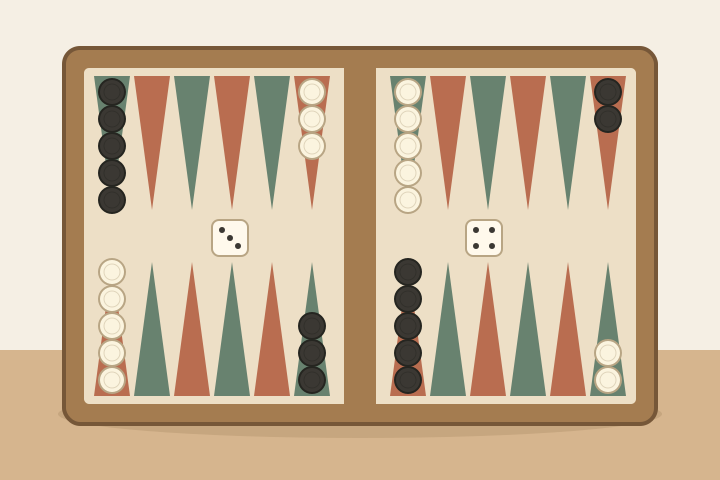
Use the illustrated setup in the rules linked below. From your own perspective, place two checkers on point 24, five on 13, three on 8, and five on 6. Your opponent mirrors this arrangement. Point 1 is closest to your exit.
For a first learning game, agree to leave the doubling cube aside and simply play to a winner. Keep a rules diagram nearby rather than trying to remember everything at once.
Basic Gear
- A backgammon board with fifteen checkers in each of two colours.
- Two ordinary six-sided dice; a pair and dice cup for each player is convenient.
- An illustrated rules guide.
- A doubling cube for later practice with scoring.
- Alternatively, a digital board with a tutorial or computer opponent.
First Session
Set aside about half an hour for setup, learning, and an unhurried first game; allow longer if you want to discuss moves. Trace both players’ routes with a finger before rolling.
Each player rolls one die to start. Reroll ties; the higher roller plays both numbers. Afterward, take turns rolling two dice.
- Treat the dice as separate moves. Using both on one checker requires a legal intermediate landing.
- A point with two or more opposing checkers is blocked. Landing on one opposing checker, a blot, sends it to the central bar.
- Checkers on the bar must re-enter through the opponent’s home board before any other checkers move.
- Doubles provide four moves of that number. Use both dice, or as many doubles as possible. If either die is playable but both cannot be used, use the higher.
- Bear off only when all remaining checkers are home. Consult the rules for rolls that exceed the occupied point.
Afterward, choose one move to discuss: did it protect a checker, create a useful block, or leave an avoidable opening?
First Month
Play a few relaxed games each week and give each session one focus. Start by checking legal moves without help, then practise noticing exposed checkers and building points occupied by at least two of your own pieces. Later, compare when to keep contact with an opponent and when to race home.
Once moving feels natural, use the references to learn gammons, backgammons, and the doubling cube. The cube changes a game’s point value; you can learn it using a paper score sheet without playing for money. Add match scoring only when both players feel ready.
Costs
Borrowing a set is a useful way to try the hobby. A basic folding board is enough for regular play; check that a second-hand set has all thirty checkers and usable dice. Decorative boards, specialist books, coaching, club fees, and tournament travel are optional later expenses.
Space Needed
A small, stable table with room for the open board and rolling dice is enough. Check the open dimensions of a folding set before buying, since storage size can be misleading. A tray or raised board edges help keep dice from escaping under furniture.
Solo or Social
The game is for two players. Solo practice can mean solving positions, replaying a decision with both sides visible, or playing a computer opponent. A regular partner makes it easy to develop a comfortable pace, while clubs and online opponents introduce different approaches.
Common Mistakes
- Mixing up the two players’ directions or starting positions.
- Adding the dice together and overlooking a blocked intermediate landing.
- Moving another checker while one is still on the bar.
- Protecting every checker automatically without considering the whole position.
- Judging a decision only by whether the next roll was lucky.
- Introducing cube decisions before both players understand ordinary moves.
Safety / Accessibility
Choose checkers that contrast clearly with each other and with the board. Larger pieces, good lighting, and a shallow dice tray can make handling and counting easier. Agree to play without a clock and say moves aloud if that helps either player follow the position. Keep small pieces and dice away from young children and pets.
Where It Can Go
Backgammon can become a regular café game, a shared family pastime, or a deeper study of probability and decision-making. Further paths include club play, position analysis, teaching beginners, and tournament matches. A comfortable board and a familiar opponent can also be the whole hobby.
References
Last reviewed: 23 September 2026.
Rules and further learning:
- Backgammon Galore: Rules of Backgammon for setup diagrams, movement, hitting, entering, and bearing off.
- U.S. Backgammon Federation: Backgammon Basics — How To Play for an illustrated rules guide, including the doubling cube and scoring.
Related Hobbies
Chess, go, board games, mahjong, and jigsaw puzzles offer other ways to enjoy patterns, patient problem-solving, and time around a table.