Who It Suits
Puppetry is the art of making and performing a character that is not a person: you build a figure, mask, or shadow shape, and then give it life through movement, timing, and voice. A beginner’s first sessions look less like theatre and more like craft plus play: making a simple sock or felt puppet, learning to make it look, listen, and react, and performing a short scene for one or two people.
It suits people who enjoy characters, voices, craft, movement, and visual storytelling. The honest appeal is that it can start at a kitchen table with household materials, that it gives shy performers a way to act through a character rather than standing fully exposed as themselves, and that the same core skills — focus, timing, stillness, clean movement — carry over from a sock puppet to a full stage production. The honest constraints are that progress is slow, a puppet only looks alive when the performer’s control is invisible, and performing to an audience (even a small one) is still performing.
Getting Started
Start with one simple puppet style before trying others. The main families:
- Glove (hand) puppet — the puppet fits over the hand; the fingers control the head and arms. The standard beginner puppet because it is cheap, quick to make, and forgiving.
- Rod puppet — a figure moved by one or more rods held in the hand; more controlled than a glove puppet, with a larger stage presence.
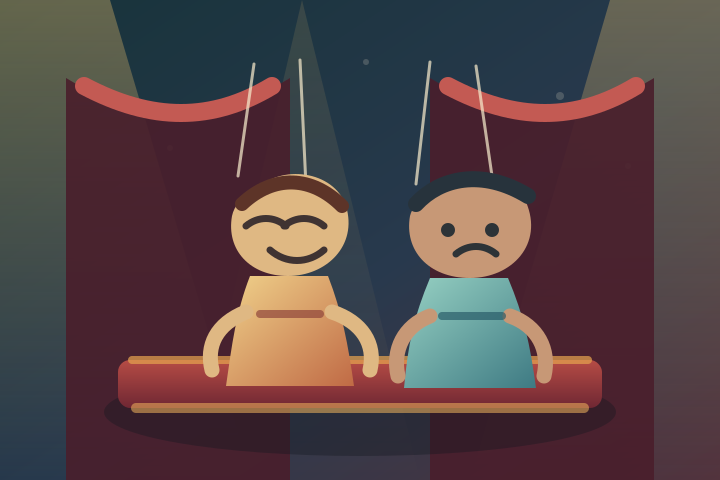
- Marionette — a figure suspended from and controlled by strings or wires, usually from a control bar held above. The most technically demanding style for a beginner.
- Shadow puppet — flat cut-out figures moved in front of a lit screen; the craft is in the silhouettes, the joints, and the teller’s voice.
- Mask — worn by the performer, who becomes the character directly; the mask changes how the wearer moves and speaks.
- Tabletop and object theatre — small figures or everyday objects performed on or behind a table, often in miniature scale.
A few terms do most of the work:
- Puppeteer — the performer; in Japanese bunraku, a single puppet is traditionally operated by several puppeteers at once.
- Sightline — the line of sight from the audience; a puppet’s eyes should point where its attention is, and the performer must check that the character reads correctly from the audience’s point of view.
- Lip sync (lip flap) — matching the puppet’s mouth to the spoken word, usually with a hinged or flapped mouth.
- Stillness — a held pause that gives a movement its meaning. Beginners tend to move constantly, and it is the stillness that makes a puppet look alive.
- Wayang — the Indonesian shadow puppet tradition, inscribed on UNESCO’s Representative List of the Intangible Cultural Heritage of Humanity; a useful model for how shadow puppetry works as storytelling, not just silhouettes.
- Punch and Judy — the long-running British street-puppet tradition of comic glove puppets, still performed at fairs and festivals.
Give the character a clear face, one strong physical habit, and a short scene or joke. A good first goal is to make the puppet look alive through focus, breath, stillness, and clean movement rather than complicated construction.
Basic Gear
Essential:
- One simple puppet to start: a sock, a piece of felt, or paper for a shadow cut-out.
- Scissors, glue or tape, and a marker or paint for the face.
- A small stage: a table edge, a cardboard box, a doorway, or a sheet held up for shadow work.
- A light source for shadow puppetry (a lamp or phone torch works).
- A phone camera for checking movement and sightlines.
Optional at first:
- Fabric, foam, wood, or found objects for more permanent builds.
- Craft knife, needle and thread, or a stapler for construction.
- Dowels, skewers, wire, string, or rods for control.
- Buttons, yarn, or simple costume details.
- A ready-made puppet kit, if you want to skip the first build.
First Session
Make a basic glove puppet — a sock with a face, or a felt head on a paper tube — and practice three actions: looking at something, reacting, and speaking or moving in rhythm. Keep the puppet’s eyes aimed where its attention should be, let movements start and stop deliberately, and hold stillness between actions. Record a short clip from the audience’s point of view and check whether the character reads: where is it looking, does the mouth move with the words, and can you still see the hand?
First Month
A realistic first-month sequence:
- Refine one puppet until it feels reliable in your hand, or build a small cast of two or three.
- Practise entrances and exits — how the character arrives and leaves is half the performance.
- Add lip sync if the puppet has a mouth, and object handling (picking up, offering, hiding something).
- Work on character voices and one strong physical habit per character.
- Perform a short scripted scene — thirty seconds to two minutes — for one or two people, and repeat it until it is clean.
- Watch different traditions and modern puppeteers with attention to control, scale, silence, timing, and how little movement is sometimes needed.
Costs
Puppetry can begin for free or nearly free: recycled materials, paper, fabric scraps, socks, cardboard, and household tools. A basic craft supply — felt, fabric, glue, wire, and paint — is a one-off purchase commonly in the region of £10–30 / US$10–30, though prices vary by region and change over time, so check current listings before budgeting. Ready-made puppets or marionette kits are commonly in the region of £30–100 / US$30–100.
Costs rise with quality foam and fabric, mechanisms, marionette hardware, lighting, portable stages, audio equipment, workshops, theatre tickets, storage, and travel to festivals or classes.
Space Needed
Small puppets need a table, floor area, or doorway. Shadow puppetry needs a light, screen, and enough distance between them for clear silhouettes. Larger rod puppets, marionettes, masks, or ensemble pieces need more rehearsal space, overhead clearance, storage, and safe room for movement.
Solo or Social
Puppetry can be practised alone through building, voice work, movement drills, and filmed sketches, but it becomes social through performances, workshops, schools, theatre groups, festivals, libraries, and collaborative shows. Many productions rely on builders, performers, writers, musicians, and stage helpers working together. UNIMA, the international puppet theatre association, maintains a directory of puppetry schools, museums, festivals, and national centres that is a good way to find local groups and events (see References).
Common Mistakes
- Starting with a marionette; it is the most technically demanding style and punishes a beginner’s uneven control.
- Decorating a puppet before testing whether it moves well.
- Moving constantly instead of using stillness and focus.
- Letting the puppet stare at the ceiling or drift away from the audience.
- Making a first build too heavy, fragile, or hard to repair.
- Hiding the performer’s body poorly when visible performance would work better.
- Forgetting sightlines, lighting, and sound until performance day.
Safety / Accessibility
Use sharp tools, hot glue, wire, paint, and adhesives with care, ventilation, and suitable supervision. Hot glue guns burn easily and are a common beginner hazard, and children should use child-safe tools and materials under adult supervision. Check the label or safety data sheet of any adhesive, paint, or solvent before use; the UK Health and Safety Executive’s COSHH guidance explains how to identify and control risks from hazardous substances (see References).
Keep puppet weight, grip strain, repetitive movement, lighting heat, trip hazards, and vocal fatigue in mind: take breaks, keep cables and rods clear of walkways, and rest your voice. Seated performance, lighter materials, larger handles, recorded audio, captions, simplified controls, and visible puppeteering can make the hobby more accessible.
Where It Can Go
Casually, puppetry can stay exactly that: home shows for family, school and library performances, festival appearances, and the general comfort of making and moving characters.
If you want to go further, the routes branch: children’s theatre, education, stop-motion animation, mask work, street performance, object theatre, film and television puppets, theatre design, prop making, voice acting, writing, directing, or community arts projects. Training ranges from local workshops to full-time puppetry schools, and UNIMA’s directory lists schools and festivals worldwide (see References).
References
Last reviewed: 18 August 2026.
Safety:
- Health and Safety Executive (UK), COSHH — guidance on identifying, assessing, and controlling risks from hazardous substances such as adhesives, paints, and solvents.
Organisations:
- UNIMA (Union Internationale de la Marionnette) — the international puppet theatre association, an NGO affiliated with UNESCO. Its directory of puppetry schools, museums, festivals, libraries, and national centres is the main way to find local groups, training, and events.
- UNIMA glossary — the association’s glossary of puppetry terms and organisations.
Heritage and background:
- UNESCO: Browse the Lists of Intangible Cultural Heritage — includes inscribed puppetry traditions such as Indonesia’s wayang shadow puppet theatre.
- V&A Collections (UK) — a museum collection of over 1.25 million objects, searchable online by material and technique; a useful reference for puppet construction, costume, and stage design.
Community resources (optional):
- Local puppetry groups, community theatres, libraries, and schools often run beginner workshops and family shows; UNIMA’s national-centre directory (see above) lists the national associations that coordinate them.
Related Hobbies
Acting, sewing, woodworking, model making, stop-motion animation, creative writing, singing, dance, cosplay, comics, and video editing all connect with puppetry through character, construction, movement, voice, or storytelling.