Who It Suits
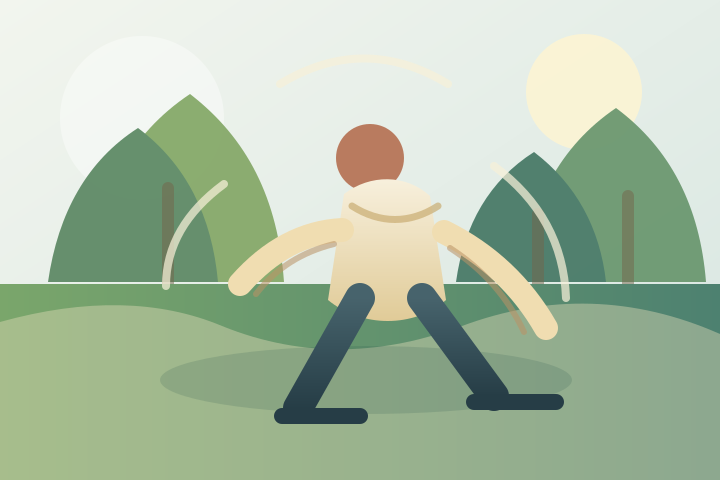
Tai chi (tàijíquán, “Taiji fist”) is a Chinese martial art that most people today practise as a gentle, low-impact exercise. A typical beginner session is a slow sequence of standing postures and weight shifts — stepping, turning, and circling the arms — performed at a walking pace or slower, with relaxed shoulders and an even breath. It is often described as “meditation in motion,” and a first class usually spends as much time on standing still and shifting weight as on learning named movements.
The art’s earliest documented practice comes from Chen Village and Zhabao Village in Henan province, China, and most modern styles trace back to five traditional schools: Chen, Yang, Wu (Hao), Wu, and Sun. In the early twentieth century, teachers such as Yang Chengfu, Wu Jianquan, and Sun Lutang began promoting tai chi for its health benefits, and in 2020 UNESCO added it to the Representative List of the Intangible Cultural Heritage of Humanity.
It suits people who want a structured, repeatable movement practice without impact or intensity, and who enjoy learning sequences by heart. The honest constraints: it is a skill, and progress is slow — smoother balance and cleaner transitions come after months of repetition, not weeks. And the traditional language of “qi” (vital energy) is part of the culture, not a scientific claim; the measurable benefits are balance, mobility, and calm.
Key Terms
- Form (taolu) — a choreographed sequence of movements practised alone or as a group. Learning a short form is the core of beginner training.
- Stance — the position of the feet and knees in a posture, for example a soft “bow” stance with one leg bent and one straight. Beginners keep stances high and shallow.
- Weight shift — moving your full weight from one leg to the other while the empty foot stays light on the ground. This is the engine of nearly every movement.
- Standing meditation (zhan zhuang) — standing still with soft knees and relaxed shoulders, often used to start or end a session.
- Qigong — a family of gentle breathing and movement exercises often taught alongside tai chi.
- Push hands (tuishou) — a two-person drill of slow, light contact used to develop sensitivity and balance; usually a later stage.
- Cloud hands — a common early movement: circling the arms in front of the body while the weight shifts side to side.
- Single whip — one of the most recognised tai chi postures, combining a turn, a step, and an arm extension.
- Silk reeling — the coiling, spiralling body mechanics emphasised in Chen style.
- Simplified 24-form — a 24-movement form created in the 1950s by Chinese sports authorities to popularise tai chi; still one of the most widely taught forms in the world.
Common Styles
| Style | What it feels like | Beginner suitability |
|---|---|---|
| Yang | Smooth, even tempo; the most widely taught health-oriented style. | The most common first style. |
| Chen | The oldest family style; mixes slow movements with sudden bursts and more athletic stances. | Usually after a year or more, though some schools teach a gentle introduction. |
| Wu (Hao) | Compact, with small steps and a strong emphasis on internal feeling. | Good once the basics are familiar. |
| Wu | Gentle, with a slight forward lean and soft, continuous motion. | Good for a very gentle practice. |
| Sun | Shorter, lighter forms that blend step work from another martial art. | Good for people who find long forms tiring. |
| Simplified / health programs | Fixed short forms (like the 24-form) or adapted programs such as Tai Chi for Arthritis and Tai Chi for Balance. | Designed for beginners and older adults. |
There is no “right” style — most beginners start with Yang or a health program and choose later.
Getting Started
Step 1: Try a Beginner Class or a Clear Video
Look for instruction that explains posture and weight shifting before asking you to copy a long form. A first class is a good way to see what the practice feels like before committing.
Step 2: Learn the Basics Well
A small set is enough: standing alignment, slow weight shifts, and two or three simple movements such as cloud hands. Learn the entry, the breath, and the exit of each.
Step 3: Build a Short Home Routine
String five to eight movements into a ten-to-fifteen-minute routine you can repeat without a video. Repeating the same short routine is how the movements become familiar.
Step 4: Choose a Style and Teacher
After a few weeks, sample a style (Yang is the common default) and stay with a teacher whose explanations make sense. There is no universal certification for tai chi teachers, so judge by experience, clarity, and whether they offer modifications.
Basic Gear
- Comfortable clothing that lets you move freely.
- Flat shoes with light grip, or bare feet on a suitable indoor surface.
- A water bottle.
- A small clear area at home for practice.
- Optional: a chair or wall nearby for support, and a notebook for remembering movement names.
A silk uniform is a nice-to-have, not a requirement — buy one only after you have found a teacher and style you like.
First Session
A ten-to-fifteen-minute beginner session you can do at home:
- Stand with feet shoulder-width apart, knees soft, shoulders dropped. Stand still for one minute, breathing normally (this is zhan zhuang).
- Slow weight shifts: shift your full weight onto one leg, then the other, keeping the empty foot lightly on the ground. Two to three minutes.
- Cloud hands: as the weight shifts, circle the arms in front of the body, one arm high and one low. Two to three minutes.
- Step forward and back: step forward into a soft, shallow lunge, pause, and return to the centre. Repeat on both sides. Two to three minutes.
- Finish standing still for one minute, feeling your weight settle evenly.
Keep the range small and the tempo slow. Use a chair or wall for support if needed, and stop if you feel pain, dizziness, or strain.
First Month
Practise two or three times a week for ten to twenty minutes. Repeat the same short routine until the transitions feel familiar, then add one or two movements. Early progress is usually smoother movement, steadier balance, and remembering the sequence — not performing a full form.
Costs
Tai chi can start almost free: clear floor space, free videos, public park groups, and community centre or library sessions. Paid options include drop-in classes, term courses, workshops, and private coaching, and prices vary a lot by region and provider — community centre classes are typically cheaper than private studio or school classes, and many park groups are free or donation-based (2026; check locally).
Space Needed
Tai chi needs enough clear floor to step forward, back, and sideways without bumping into furniture — roughly a 2 m × 2 m (6.5 ft × 6.5 ft) square. A quiet room, garden, park, studio, or community hall can all work. A non-slippery surface matters more than a large space.
Solo or Social
Tai chi works well as solo practice once you know a short routine, and group classes help with rhythm, posture, feedback, and consistency. Many people enjoy the calm social structure of a park group or community class, and World Tai Chi & Qigong Day (the last Saturday of April) offers free public sessions in many cities.
Common Mistakes
- Trying to learn a long form before the basics feel steady.
- Locking the knees or forcing low stances.
- Moving quickly instead of clearly.
- Holding the breath.
- Tensing the shoulders and gripping with the hands.
- Treating tai chi as only stretching and ignoring balance, posture, and intent.
- Buying a silk uniform or equipment before finding a teacher you like.
Safety / Accessibility
- Balance challenges, knee strain, and fatigue can still happen in a gentle practice. Keep stances high and movements small at first, and use a chair or wall for support if needed.
- Stop any movement that causes sharp pain, numbness, or dizziness. If you have joint problems, are pregnant, or have had recent surgery, check with a doctor before starting and tell your teacher.
- The evidence is real but modest: a 2017 meta-analysis found tai chi decreased falls in older people, and a 2015 review found it could be practised safely by people with chronic conditions such as cancer, osteoarthritis, heart failure, and COPD. A 2022 NIH analysis concluded the overall evidence is low quality but suggests a small positive effect on quality of life. There is no scientific evidence for “qi” as a measurable energy.
- Accessibility: chair tai chi and wall-supported versions exist, and adapted programs such as Tai Chi for Arthritis and Tai Chi for Balance are designed for older adults and people with joint pain. Ask an instructor about modifications for dizziness, pregnancy, or mobility limits.
- Outdoors: park practice is popular, but watch for uneven ground, wet leaves, and heat; drink water and avoid practising in strong sun.
Where It Can Go
Tai chi can lead toward longer traditional forms, qigong, push hands, weapons forms (spear, sword, and fan, taught with appropriate instruction), competition (wushu taijiquan), meditation and breathwork, balance training, martial arts history, or teaching.
References
Last reviewed: 18 August 2026.
Editorial note: This guide is beginner hobby-discovery guidance, not medical advice. There is no universal certification for tai chi teachers; judge instructors by experience and clarity. Class prices and availability vary by region and provider; the cost notes above are rough guides as of 2026.
Official and authoritative sources:
- Wikipedia: Tai chi — history (Chen Village origins, the five traditional schools, early twentieth-century health promotion), the 2020 UNESCO Intangible Cultural Heritage listing, terminology (taolu, zhan zhuang, tuishou, weapons), and a summary of the health research.
- Lomas-Vega et al., “Tai Chi for Risk of Falls. A Meta-analysis” (2017), Journal of the American Geriatrics Society — meta-analysis finding that tai chi decreased falls in older people.
- Chen et al., “The effect of Tai Chi on four chronic conditions” (2015), British Journal of Sports Medicine — systematic review finding tai chi could be performed safely by people with cancer, osteoarthritis, heart failure, and COPD.
Community resources (optional):
- World Tai Chi & Qigong Day — free public sessions on the last Saturday of April in many countries, plus free beginner tutorials and a local event listing.
- Tai Chi for Health Foundation — Tai Chi for Arthritis and Tai Chi for Balance programs; search for a local certified instructor.
- Local parks, community centres, and libraries for beginner classes and free or low-cost sessions.
Related Hobbies
Yoga, meditation, Pilates, dance, martial arts, hiking, journaling, gardening, and photography all pair well with tai chi.